
From runs in 2023 to revs in 2026: Rachin Ravindra's second World Cup surge
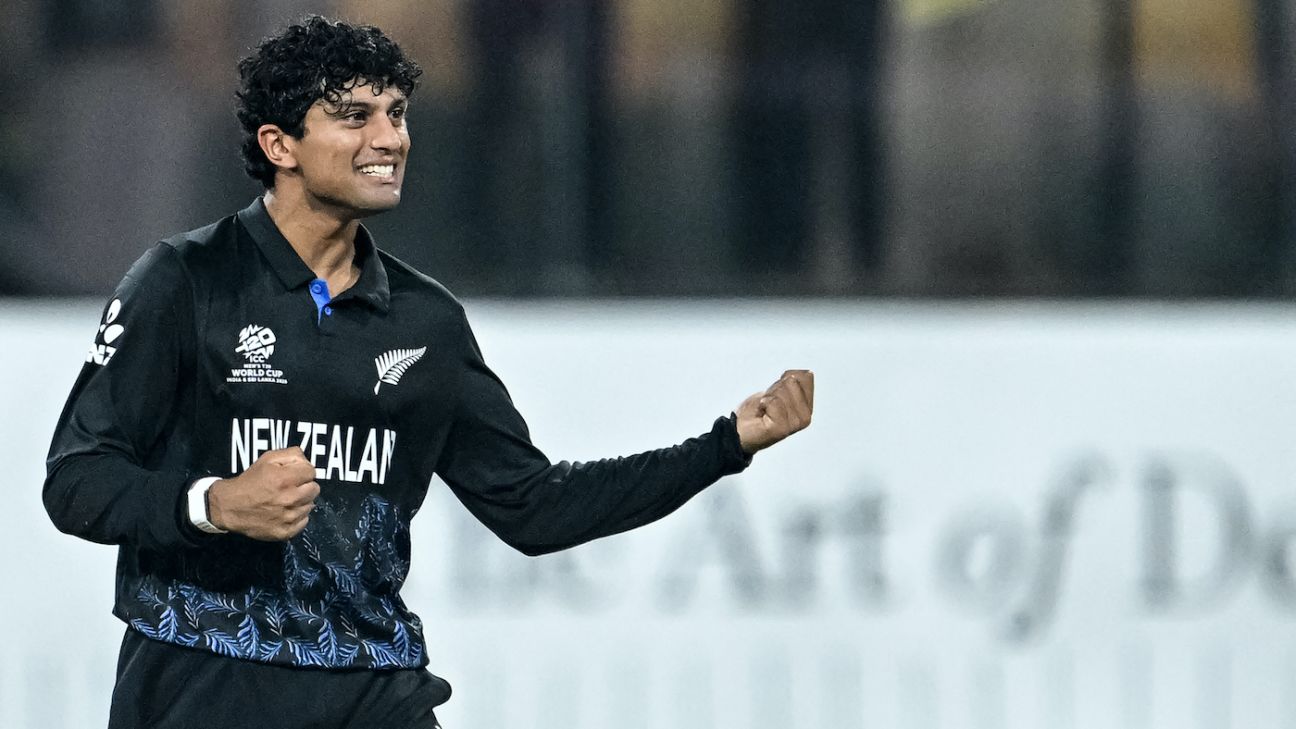
Ravindra's subtle variations have powered New Zealand's run to the final, but India's left-hand heavy line-up could be his biggest test yetDeivarayan MuthuPublished: Mar 6, 2026, 8:31 AM (2 hrs ago)In the 2023 ODI World Cup in India, Rachin Ravindra unexpectedly opened the batting, after he was originally picked in the squad as a spare player, and ended up matching Kane Williamson's tally of most runs by a New Zealander in a single edition of a men's ODI World Cup. Three years later in a T20 World Cup in India and Sri Lanka, he has unexpectedly made a big splash with the ball.Ravindra already has 11 wickets in the tournament, matching Daniel Vettori's record for the most strikes by a New Zealand spinner in a T20 World Cup, and is three away from toppling Trent Boult's all-time New Zealand record.In the final against India on Sunday, Ravindra's left-arm fingerspin could be challenged by India's left-hander heavy line-up. While Ravindra has excelled against right-hand batters in the competition, claiming eight wickets in six innings at an economy rate of 6.32, he hasn't been too shabby against the left-handers, taking three wickets in four innings at an economy rate of 8.44.There's no mystery around Ravindra's bowling. Like his captain Santner, he is a classical left-arm fingerspinner. Unlike Santner, he doesn't pause in his action, and mostly relies on variations in pace and length. In spin-friendly Colombo, Ravindra liberally tossed the ball up and hid it away from the swinging arcs of batters, denying them access to the shorter boundary. On flatter surfaces in India, Ravindra has been alert to darting the ball quicker while maintaining control over his length.In the semi-final against South Africa at Eden Gardens, Ravindra looped one up at the stumps at 83kph and had Aiden Markram, the form batter of the tournament, holing out to long-on. Markram shaped for a step hit, but he couldn't reach the pitch of the ball. Against the left-handed David Miller, he speared the ball into the pitch and pushed it away from his hitting range, having him caught at long-off.Subtle variations. Big impact."For me, it's just trying to make the batter's life as hard as possible," Ravindra told the host broadcaster after helping New Zealand secure their place in the final. "That's changing pace, changing my seam angle, changing my angle, just doing little things like that."Lance Dry, the former Wellington spinner who has coached Ravindra at Firebirds, offers more insight into his spell against South Africa at Eden Gardens."Like Michael Bracewell, Rachin has the same level of bowling intelligence as his batting intelligence," Dry told ESPNcricinfo. "When he was bowling to right-handers, he was bowling traditional fingerspin - the seam was up and pointing towards third man. Against the left-handers, he never bowled any deliveries like that and just bowled scrambled seam because he didn't want to turn it into their arc and was looking for some variability in bounce, which worked."In Colombo, Ravindra had a bit more to work with, including drift. Against Dasun Shanaka, he got one to drift in, then turn away sharply, to draw a mis-hit to short third. The ball stopped at a street shop for a bite of kottu roti before eventually arriving for Shanaka at the Khettarama."I've always thought about it [drift]," Ravindra said. "I've always put it into the wicket, and these services have been handy to do that. It's always interesting, because you think it's a left arm, and you drift it back into the right [hander], but sometimes, at the same time, it does go [away] a little bit. It's just trying to have a little bit of guile and try to keep it out of their [batters'] arcs, as we know how good the wickets are on T20 cricket, and just trying to contain them in any sort of way."Having Santner do his thing at the other end has certainly helped Ravindra. "I mean, to be honest, it's a nice feeling being able to bowl from the other end. Santner - he takes those hard overs and he's so skilled. Batters try to take him down and potentially take a few risks against me, which I'm happy about."RelatedFlying Finn launches NZ into the final with record tonNew Zealand get Phillips and Ravindra ready for bigger challengesNew Zealand do New Zealand things to beat the oddsRavindra now sees himself as a batter "first and foremost," but when he had entered New Zealand's Under-19 set-up as a 15-year-old, there was more hype around his bowling. The guy's still New Zealand Under-19s' third-highest wicket-taker, with 26 strikes in 15 innings at an economy rate of 5.20."When Rachin was in the Under-19s, yes he was picked more as a spinning allrounder rather than a batting allrounder," Dry recalled. "But at the time, he was quite slight and his ball-striking wasn't there and he batted down the order. His main skill was his bowling and has always been accurate."As he made the step up to Wellington and New Zealand's white-ball sides, bowling took a back seat but along the way, Ravindra learnt to put more revs on the ball. Though New Zealand's pitches don't offer much turn, Ravindra managed to shut batters down by generating some extra bounce with overspin and varying his pace."Rachin's natural seam position is more a topspinner and more overspin than a square-seam side-spinning delivery," Dry explained. "It's because of those reasons around our surfaces. At Wellington, Rachin also deals with the wind. That helps in the long run when you go somewhere else where you have to control your pace."Bowling downwind is a completely different proposition to bowling into the wind. Over time and the number of overs he bowls at the nets in Wellington, which are exposed to all the elements, he's been able to develop that ability and now he's getting the opportunity to show off a little bit."Ravindra also has exposure outside of New Zealand. When he visited the CSK academy in 2024 ahead of a Test series in India, he worked on accurately hitting an in-between length. One of his drills involved landing the ball on a cone placed between a good length and a half-volley length. All of that grounding has set Ravindra up for success in this T20 World Cup.However, when the World Cup began, Ravindra was "deep in the bush," his Wellington team-mates Tim Robinson and Peter Younghusband said on The Cricketers Network last month. Ravindra coined the term himself, which could mean a number of things. Lost. Confused. Struggling for form.Ravindra was in this place after he was dismissed for a golden duck by a ripper from Mujeeb Ur Rahman at Chepauk. India's left-handers might leave Ravindra "deep in the bush" once again, but count him out at your own peril.He is regarded as one of the best problem-solvers in this team, which is why the Black Caps have earmarked him as their next big all-format player after Williamson. On Sunday, he has a chance to achieve something that even Williamson hasn't done so far: win a World Cup."I think as a kid you dream of these moments," Ravindra said. "I think there's 100,000 plus people at the seating [in Ahmedabad], and it's one of those moments you pinch yourself and you always want to play. You watch World Cups, you grow up...and it's really a pinch yourself [moment] to be able to play a World Cup final in India."Deivarayan Muthu is a senior sub-editor at ESPNcricinfo


.jpg)
Most Popular


Arsenal, Chelsea aim to avoid FA Cup upsets
15 hours ago

.jpg)