
Nuwan Thushara files lawsuit against SLC for IPL NOC
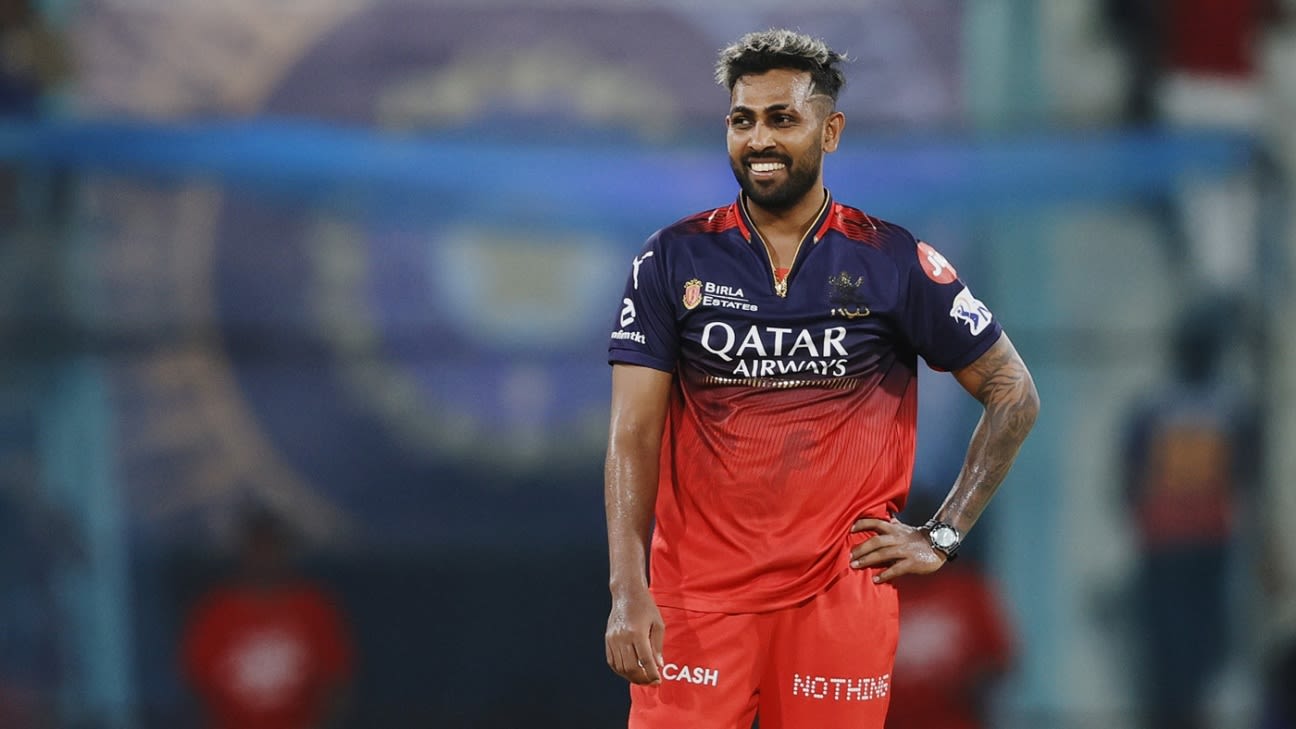
RCB bowler's argument is that his SLC contract ended on March 31, making the enforcement of an NOC unreasonable and a barrier to his livelihoodMadushka BalasuriyaPublished: Apr 2, 2026, 12:37 PM (1 hr ago)Sri Lanka fast bowler Nuwan Thushara has filed a lawsuit in the Colombo District Court against Sri Lanka Cricket (SLC) after he was denied a no-objection certificate (NOC) to play in the IPL as a result of failing new and stricter fitness tests.Thushara's legal argument centres around his contract with SLC ending on March 31, 2026 - after which he intended to step away from international cricket - making the enforcement of an NOC for SLC unreasonable and a barrier to his livelihood. While Thushara's argument notes the loss of income from missing the IPL - he's part of the Royal Challengers Bengaluru (RCB) squad - the timing of the legal action has almost certainly ruled him out of the tournament.RelatedThushara fails fitness test, denied NOC to join RCB in IPL 2026Sri Lanka players told to clear fitness test to get NOCs for IPL 2026High Court directs CSA to let Shamsi complete ILT20 seasonThe case, in which SLC president Shammi Silva, secretary Bandula Dissanayake, treasurer Sujeewa Godaliyadda and CEO Ashley de Silva have been named defendants, is set to be taken up again on April 9. That date is the earliest the case can be heard as Sri Lanka's courts will be closed over the Easter weekend, and even then it is extremely unlikely that it will be settled in a single hearing. This means Thushara will at the very least miss two more weeks of the IPL, which began on March 28.ICC regulations stipulate that an NOC from a home board is required to participate in overseas leagues, but they do not mention specific criteria a home board must use to grant or deny it. The ICC leaves the conditions for issuing an NOC to the discretion of the individual boards. This allows boards to follow their own internal policies for granting the NOC; for example, SLC has previously denied NOCs based on players being allowed to participate in two overseas leagues a year.The question of whether SLC can legally withhold that certificate from a player who is no longer under a central contract is now set to be tested. As per legal documents seen by ESPNcricinfo, SLC had formally informed Thushara that he would not be granted an NOC on March 24. Thushara claims to have requested an NOC multiple times, verbally and in writing on March 15 and 23, before eventually being denied. While SLC is yet to respond to his follow-up on March 28, Thushara claims he was informed unofficially that he would once again be denied the NOC.SLC's reasoning centres around its new mandatory fitness requirements, which have been spearheaded by the selection committee led by former fast bowler Pramodya Wickramasinghe following Sri Lanka's poor performance in the recent Men's T20 World Cup.There are five components to the SLC fitness test: a 2 kilometre run, 20 metre sprint, a 5-0-5 agility test, a skinfold test, and a counter movement jump (CMJ). Each of these tests allows for a player to gain a maximum of 29 points total - players need to attain at least 17 points to be considered for selection - with the 2km run and skinfold test holding the most weight."If you fair poorly in those two, it will be very hard to pass," a SLC source told ESPNcricinfo. These tests have been a regular part of player training since 2021. However, they were not used as strict selection criteria, rather as a guide, particularly when making calls between two similarly skilled players.Central to Thushara's argument is that such fitness requirements were not a prerequisite for an NOC in the past, and that his current fitness levels are consistent with what he has maintained over his career, including in 2024 and 2025 when SLC had granted him NOCs.Thushara's case has similarities to that of South Africa's Tabraiz Shamsi, who took Cricket South Africa (CSA) to the Johannesburg High Court in December 2025. He was not centrally contracted by CSA and had withdrawn from an SA20 league contract. CSA refused to grant him a full-duration NOC to play in the rival International League T20 (ILT20), aiming to protect its own tournament's player pool. Shamsi argued that because he held no active contract with either CSA or the SA20 franchise, the board's withholding of the NOC was an act of "bad faith" to protect its own commercial interests. The South African High Court sided with Shamsi, issuing an interim order forcing CSA to grant the full NOC, setting a major precedent for global player mobility.The Shamsi ruling proved that when a player is outside a central contract, a board cannot use the ICC's NOC policy purely to protect its commercial interests. Thushara's case takes this a step further, and asks whether a board can legally enforce its internal selection policies on a player who has walked away from the national set-up.

.jpg)
Most Popular

1 in Charleston comeback, first win in 8 months
13 hours ago


Solorzano Named MIAA/GAC South Athlete of the Week
14 hours ago


Redbirds Top Bulldogs 5-2 in Road Matchup
14 hours ago

Jakovich named WAFL Eagles Ball Legend
14 hours ago