Mouthy Ireland stuck in neutral ahead of Six Nations
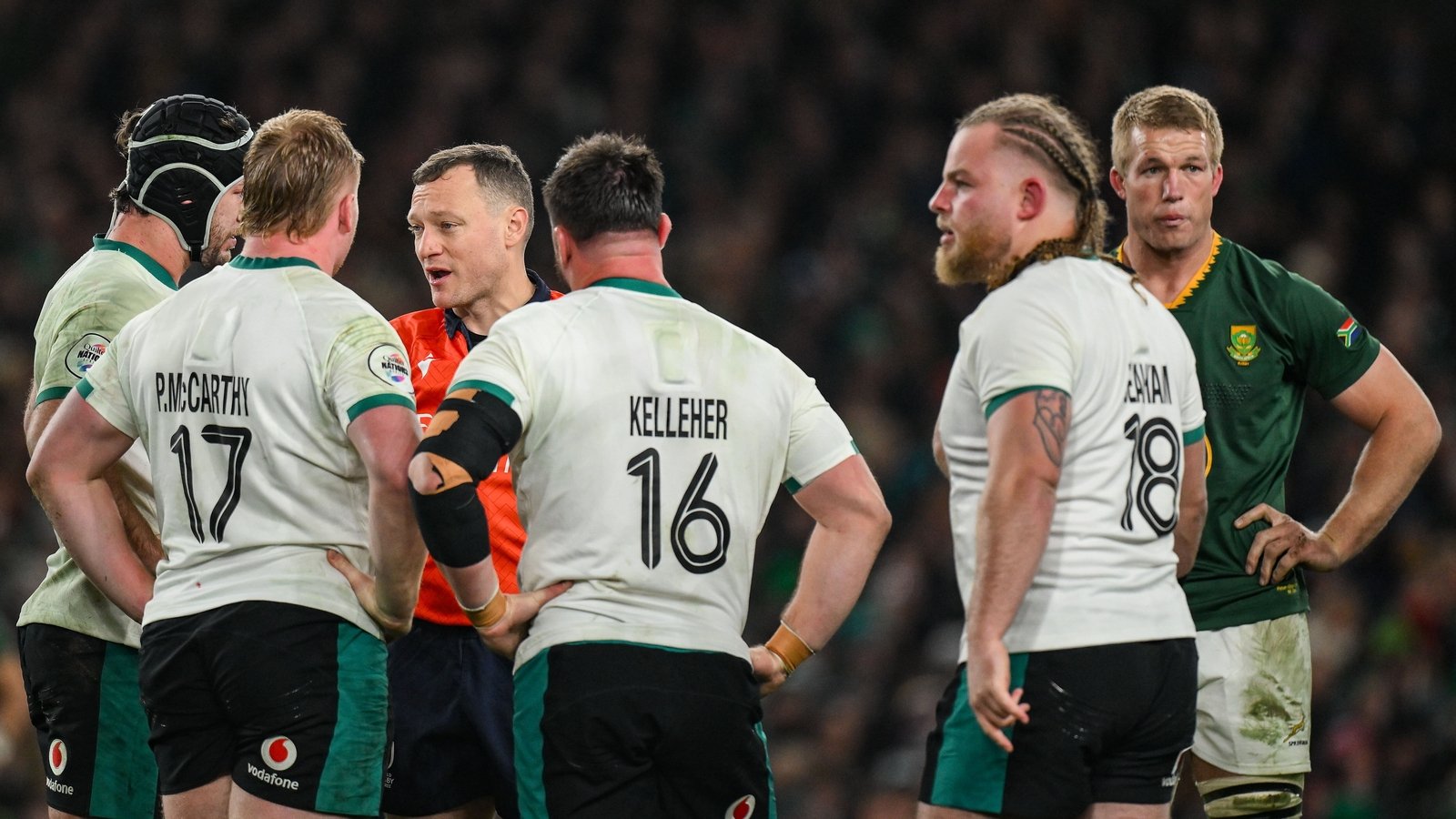
The latest installment of the Six Nations arrives with Irish rugby feeling more ill at ease with itself than it's been for some time.This is usually a magical time for rugby fans, when old montage videos proliferate on social media.Tom McGurk perambulating by the Grand Canal, delivering a self-penned soliloquy on the majesty of the Six Nations, accompanied by black and white footage of Mike Gibson tossing a deft reverse pass and Ginger McLoughlin hod-carrying both packs over the line in Twickenham.Old tropes are fondly recalled. George Hook offering a wholly counter-intuitive pre-match prediction, citing a Shakespeare play as part of his rationale.But this year, one senses disquiet on a number of fronts.For a start, the traditionalists are presumably dismayed to learn that this year's Six Nations gets under way on a Thursday night.It can't be doing much for the prestige of the 2026 edition that it's commencing on an evening more commonly associated, in sporting terms, with the Europa League.This is usually the night when an idle flick through the channels will lead you to Brian Kerr expounding at bewildering length on the deficiencies of the Eintracht Frankfurt defence. ("The lad Koch isn't comfortable facing his own goal and I think Udinese will exploit that in the second half.")But now Kerr is elbowed out of his usual perch in Ballymount on a Thursday night for the rugby lads.Supposedly, the French broadcasters don't want the France-Ireland game to collide with the opening ceremony of the Winter Olympics, which must be more of a draw there than it is with the everyday punter in these parts.The custodians of the game have bigger problems on their hands than scheduling, however.We're told that the whole culture of the game is in a state of deterioration. The proud ethos of respect is fading.The level of mouthy back-chat has reached epidemic levels and Ireland are reportedly among the worst offenders.This is a quite stunning role reversal with Gaelic football - previously the gold standard in referee abuse - where nowadays if you look sideways at a ref, he basically awards two points to the opposition.How long before the likes of David Coldrick and Michael Oliver are reprimanding unruly players by reminding them that it isn't rugby union they're playing?Bundee Aki has been banished to the naughty step for the first three games, which include the two big away matches.The authorities were moved to act after Aki vented his feelings to referee Eoghan Cross not alone on the field but in the tunnel afterwards in Connacht's defeat to Leinster.Matthew Carley, who received a ferocious barracking from the Irish crowd in November, penalised Munster in their loss to Castres for repeatedly demanding penalties at a ruck. Leinster had a penalty awarded against them for dissent in their Christmas period win in Thomond Park.Ireland captain Caelan Doris, by all accounts, hasn't mastered the subtle art of lobbying a ref without getting his back up."It's incredible the amount of chat from Irish players," observed Bernard Jackman on the RTÉ rugby podcast last week. "Across the board, not just captaincy-wise. It's non-stop. Every ruck there's four or five players in a provincial jersey shouting and telling the referee what to do."The Irish Independent's Ruaidhrí O'Connor noted that Irish rugby teams seem to have a specific issue relating to English referees, and this two-and-a-bit years after long-time bete noire Wayne Barnes hung up his whistle.Ominously, three of Ireland's games this spring are presided over by RFU officials - Karl Dickson, twice, and Luke Pearce.Perhaps Richie McCaw can release one of those online masterclass videos where he explains how you can compel a referee to do your bidding without alienating him.Maybe some eminent smooth-talker from the diplomatic corps can be drafted in to give Doris and co a few pointers, much as Brian Fenton was called in to help with their high fielding?Luke Fitzgerald has gone further and suggested the Irish players go cold turkey on speaking to refs altogether - as a kind of 'circuit breaker' to halt the addiction.Over winter, it became apparent that the Irish players' disenchantment isn't just confined to the whistlers but is also aimed at the higher-ups issuing the directives.Much like Gaelic football nowadays, the rules, or laws, of rugby union are in a constant state of revision and refinement. One subtle tweak every couple of years and a previously unassailable team can have the legs cut from under them."The style of the game has gone backwards, let's be honest," Tadhg Beirne declared bluntly after Munster's loss to Leinster at the Christmas interpro in Thomond.The fault for this state of affairs is attributed to the clampdown on 'escorting', which the layman might understand as a euphemism for obstructing.In rugby, 'escorts' are those lads who loiter in the path of the opposing team's chasers after the scrum-half has hoiked a garryowen into the sky - unobtrusively enough that they don't physically block said chasers but sufficiently so as to prevent them getting a clean run at the catcher.But now that the powers-that-be have cracked down on the escorts, teams have decided that lamping the ball into the clouds is even more of a no-brainer than it was before."Teams are just kicking the ball," continued Beirne. "Why? Because it's a 50:50 chance of getting the ball back."It's a 50:50 in the air, you get a knock-on, you get a scrum. If you've a good scrum, you get a penalty, you go to the corner. It's just becoming a set-piece and kicking game."And all down to the rugby authorities deciding to take a more hawkish line on the escorts. Who knew that these apparent nuisances were fulfilling such a vital ecological function in protecting the game as a spectacle?Whatever the reason, the provinces aren't exactly pulling up trees this season.Munster are gone from Europe in the pool stage. Leinster are still winning games but with markedly less flourish than usual. Connacht, notwithstanding their shiny new stand, seem to have gone backwards. Ulster's upturn in form has bucked the trend, at least.Ireland had what was regarded as a regressive year in 2025, at the end of which many supporters had actually forgotten that the team had won the Triple Crown.The Triple Crown, back in the days when it was still an imaginary trinket, once occupied a treasured place in Irish sport. The '82 and '85 Triple Crown triumphs were given the full elongated Reeling in the Years treatment, complete with footage of tries and scores from every match. The 2025 Triple Crown might struggle to make the edit at all.The year concluded with a defeat to a mediocre New Zealand side - who have since purged their head coach - and then a loss at home to South Africa, a faintly farcical affair which saw four yellow cards and dragged on longer than the Super Bowl.The latter game is certainly the one that lives longest in the memory, in large part thanks to the exertions of South Africa's online fanbase, which is so mobbish and confrontational it's a small wonder the Russian government hasn't been accused of mobilising them. As an experience, getting beaten by South Africa at rugby is a bit like losing a game of snooker to a 6ft 5 gangster's enforcer, who then pins you to the floor and forces you to repeat the scoreline back to him over and over for the next hour.All told, rarely has it felt more inevitable that Ireland are going to be finishing third in the Six Nations.This is partly down to it being an 'even year', traditionally a more difficult proposition for Ireland, entailing as it does trips to Paris and London (this didn't pertain so much in the Joe Schmidt years when France were still a mess and Cardiff became a fortress again).France have such an abundance of riches, Fabien Galthie has been able to drop a clutch of stars, including Damian Penaud.England, the closest northern hemisphere approximation to the Springboks, have returned to good health after the fear and loathing of the late Eddie Jones years. Steve Borthwick has leaned into their traditional qualities with a proudly simple gameplan.Home advantage is assumed to be wasted on the other three. Recent history indicates that Ireland would beat Wales, Italy and, yes, Scotland in any location.The latter's record against Ireland is veering into Vitas Gerulaitis-Jimmy Connors territory and they surely must be due a win at some point.But then their only victory in Dublin in the 21st century came in a bizarre game in Croke Park in 2010, when Johnny Sexton was still afflicted by his early career kicking yips, a state of affairs not helped by the fact that ROG's smiling face popped up on the big screen every time he dragged one wide.The often spiteful back-and-forth with the Welsh has given way to respectful, philanthropic concern. Wales aren't so much the sick man of the competition, as completely bed-ridden at the minute. "Wales not being competitive, there's a massive piece of everyone's heart missing," Ronan O'Gara told BBC Wales this week.The Welsh crisis is the biggest downer on the tournament and does put Ireland's current cyclical mini-slump into some perspective.Follow a live blog on France v Ireland in the Six Nations on Thursday from 8.10pm. Listen to live commentary on RTÉ Radio 1Watch France v Ireland in the Under-20 Six Nations on Saturday from 7.50pm on the RTÉ News Channel and RTÉ Player


.jpg)
Most Popular

Finishing second is a huge improvement: Klinger
7 hours ago