When will their dominance end? India’s batters monster Kiwis in World Cup final
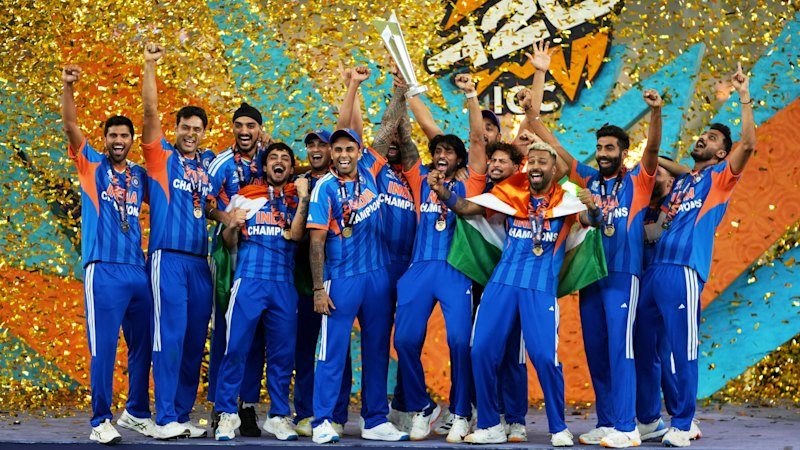
A little over two years ago, Australia won the toss and sent India in to bat in the one-day international World Cup final at the cavernous Narendra Modi Stadium in Ahmedabad.What followed was a memorable storming of the Indian fort by Pat Cummins’ team: perfectly planned and executed to stun the hosts, who had marched all the way through the tournament in full expectation of a home victory.The sting of that defeat, in fact, has been writ large across India’s white-ball teams ever since, and they have now lifted a third global trophy in a row after a commanding performance at the same stadium where Cummins had accepted the Cup from Modi.In the early hours of Monday morning, New Zealand tried the same trick as Australia, sending India in to bat in the T20 World Cup final, and were summarily thrashed. Following the retirements of Virat Kohli and Rohit Sharma, the Indian T20 team is now purely composed of players raised and schooled in the era of the Indian Premier League, and there was no fear in their assault on the Black Caps.The destruction of New Zealand’s bowlers began with 52 from 21 balls by 25-year-old Abhishek Sharma, Travis Head’s opening partner for Sunrisers Hyderabad. Sharma had endured a difficult tournament, dropped after a run of three consecutive ducks early on, but here he showcased the power and brio that got him in the side.At the other end was wicketkeeper Sanju Samson (89 off 46 balls), India’s leading scorer in the Cup with 321 runs at a strike rate of 199.37, despite playing just five games. At 31, Samson is no tyro, but his impression on the tournament is notable for the fact he was considered one of the first Indian players to make their name and reputation purely through IPL displays.Together, the openers put on 98 in seven overs, a platform which – despite Australia’s collapse from a similar position against Sri Lanka during their quick elimination from the event – was crucial to putting up a score that New Zealand could never reach.The Black Caps’ bowling analyses were not for the squeamish. Lockie Ferguson, the quickest bowler in New Zealand, went for 48 from two overs, while Jacob Duffy (0-42 from three) and spearhead Matt Henry (1-49 from four) fared only slightly better. At times, they were met as if they were bowling machines, where India’s batters had been told in advance where the ball would land and at what speed.It was number three Ishan Kishan who ensured the fast start was exploited fully, adding his own half century and helping Samson lift India to 1-203 in 15 overs before they were parted. New Zealand breathed momentarily when Samson, Ishan and skipper Suryakumar Yadav all fell in the 16th over, bowled by Jimmy Neesham, but Shivan Dube took 21 runs from the final over of the innings to vault India past 250.With 5-255 on the board, India had amassed 508 in total across the semi and final. It was a level of batting destruction that took the format to a new level, much as Sri Lanka in 1996 and Australia later on did so in the 50-over game.Chasing that many runs, New Zealand’s faint hopes rested with their supercharged openers Tim Seifert and Finn Allen. Seifert clobbered 21 runs from the second over, delivered by Hardik Pandya, but the flurry of boundaries was not sustained.This was the case in large part due to the one remaining “galactico” from former Indian teams, the singularly brilliant fast man Jasprit Bumrah.Bowling the fourth over, he struck with his very first ball, fooling Rachin Ravindra with a change of pace and rejoicing when the resultant edge was claimed by a diving Ishan in the deep. Bumrah would later explain that simply bowling fast was not enough.“Because I’ve played on belters over here, I have also seen the other team, how they were bowling ... I have learnt over here when you are trying to bowl too fast, it gets easier,” Bumrah said.“Shot-making gets easier, sometimes the ball skids on [to the bat], so keep being smart, keep changing your pace and expect what the batsman is trying to do.”New Zealand slid quickly to 5-72, and the game was essentially done. Though Seifert persisted, and captain Mitchell Santner performed a rearguard, their efforts served largely to give a crowd of 86,824 more time to celebrate the looming reality of back-to-back T20 World Cups for India as the Kiwis were dismissed for 159.Watching it all with a grin from ear to ear was International Cricket Council chair and former BCCI secretary Jay Shah, sitting in the stadium he had helped his father, Amit Shah, construct a decade ago. The glee on show made a rich contrast with the sullen faces of 2023, a memory that Bumrah was quick to recall as the trophy was wheeled out to be handed to the hosts.“It feels extremely special because I played one final at my home venue and couldn’t win that one,” Bumrah said.“This one feels really special. I was really motivated.”Spurred by 2023, India are now making the very most of their unrivalled talent pipeline, and hoovering up global trophies as quickly as the ICC can put them up for contest.

.jpg)
Most Popular

NNL boss Aluo urges patience for league reforms
10 hours ago