
The greatest 2026 T20 World Cup performance
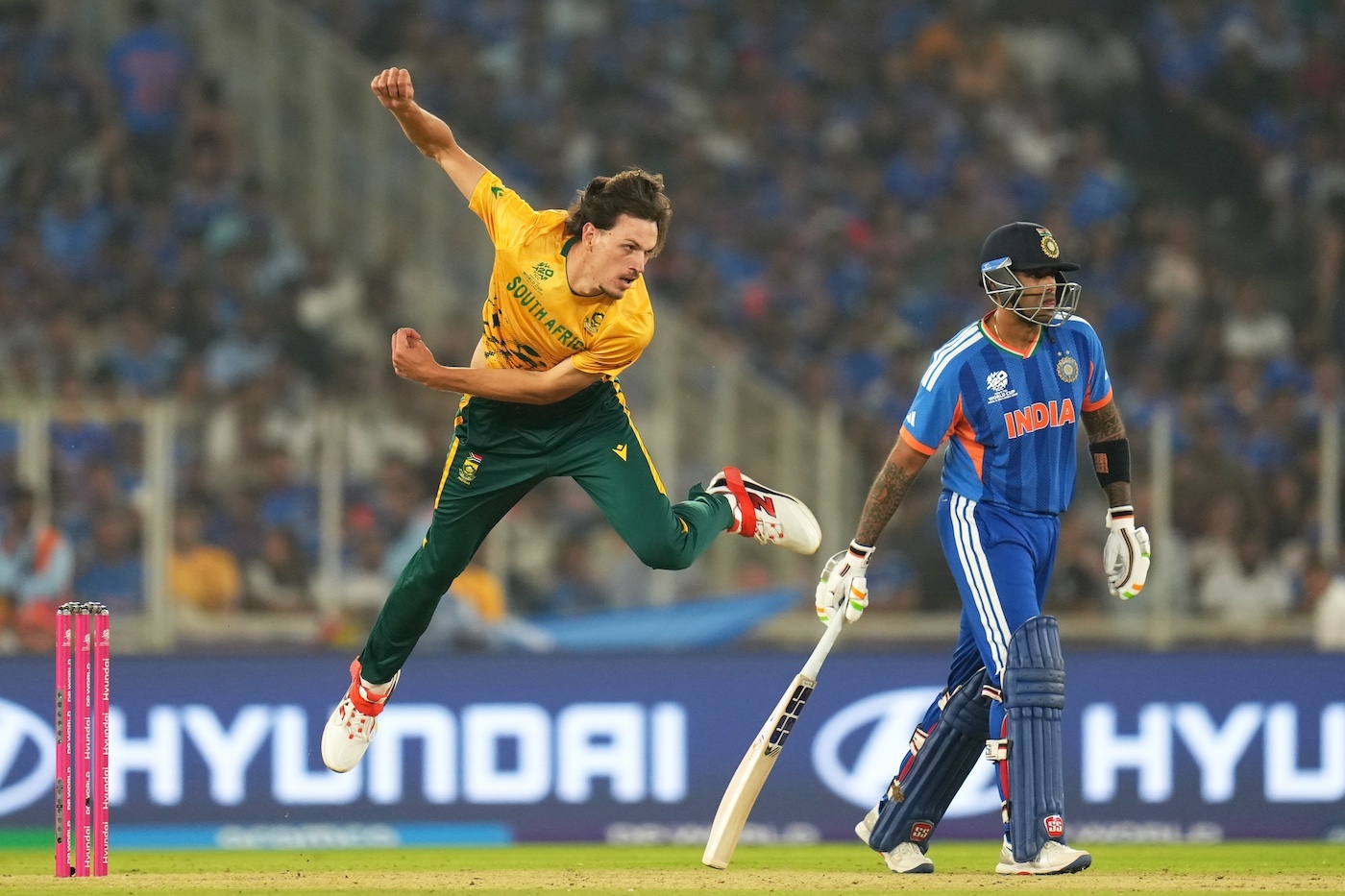
Marco Jansen4 for 22 vs India, Super Eightby Firdose MoondaThey called South Africa versus India in the Super Eight the final before the final (and it might have been a more competitive final if it had actually been the final), and its outcome pointed to a different winner than the eventual one. South Africa's dominant win over India fuelled belief they could finally go all the way. That they didn't has been dissected and will continue to beggar belief considering the stellar cast they had at their disposal, which included Marco Jansen 2.0.No longer the nervous (almost) newcomer who got the yips so badly he conceded 94 runs in 9.4 overs, including seven wides and a no-ball, against India in the 2023 ODI World Cup, Jansen had matured into a real man, as he put it himself, with a skill set to match. Express pace, bounce, and the ability to swing the ball was always there, as was the challenge he poses with the left-arm angle, but he added the "palm ball," to his arsenal. In a tournament where slower balls had high value, it was both a timely and effective trick.Jansen describes it as holding the ball neither deep in the hand nor gripping it with the fingertips but a perfect in-between. The idea is to disguise the height of his knuckles over the top of the ball (and Jansen does have big enough hands for them to be visible) so the batter thinks the regular quick one is coming but is deceived by lack of pace and is usually early through the shot and mishits. Abhishek Sharma was the perfect example in this match. Coming off a hat-trick of ducks, he scored his first runs off South Africa and seemed to be finding rhythm and was mid-swing through a lofted shot when the ball reached him and caught the inside splice of his bat to go very high, but not as far as he would have wanted. He was caught well inside the boundary.By then, Jansen had already removed Tilak Varma - with his first ball, mind you - in more routine fashion. That was a length ball on fifth stump that found an edge and left India at 5 for 2 after seven balls. They were 26 for 3 in the fifth over and Jansen was responsible for two-thirds of that damage. He made South Africa's total of 187 for 7, which was only good enough to tie against Afghanistan, tower over India.After Corbin Bosch and then Keshav Maharaj ran through most of India's middle and lower orders, Jansen returned and got Shivam Dube and Jasprit Bumrah back to back with two more of his signature slower balls. After bowling them out in the 19th over, South Africa ended India's T20 World Cup winning streak at 12. That made as strong a statement as possible about how strong they were.For Jansen, it was complete redemption. Where he had stumbled on the biggest stage against this opposition before, he succeeded this time. His performance can't be mentioned without the support act of Lungi Ngidi, the master of South Africa's slower ball, whose four overs cost 15 runs and included 11 dots in what was an all-round excellent display in the field.All that came to nought. India won the final on the same ground where South Africa beat them and lifted the T20 World Cup. But on a different night in Ahmedabad, South Africa really thought, no, let's go as far as "believed", they could be champions.We're all pally in Pallekele: catch a game in Sri Lanka and feel the love © Getty ImagesThe Sri Lanka crowdsby Andrew Fidel Fernando"I'm proud to be Australian, but how good are the Sri Lankan people?Sri Lanka is the best country in the world!" Sri Lanka had just trounced Australia to send them to brink of an embarrassing elimination in Pallekele. Yet, while leaving the stadium with a euphoric Sri Lankan crowd, this young Australian man - wearing his team's kit - parked himself in front of a television camera with friends, and went all "how good are the Sri Lankan people?" on the mic (0.24).Drunk? Possibly. But just being hammered doesn't by itself lead to these results. High on Lankan stadium vibes? Almost certainly. Well done, team. Now, someone please pick this adoring foreign man up and toss him in the pile with the others.White men becoming borderline obsessed with Lankan cricket vibes has been a thing for a while, of course. Tony Greig was the most famous example. Mike Marqusee - the American writer, whose War Minus the Shooting is one of the greatest cricket books ever written - was equally besotted, dwelling appreciatively on the "relaxed hedonism" of Sri Lankan cricket, which was a broad observation about Sri Lanka's cricket culture rather than its cricket itself. There have been others since.But this is absolutely not the only genre of humans that has been won over - just, perhaps, the most conspicuous. In 2017, Pakistan beat Sri Lanka in the Champions Trophy to qualify for the knockouts, but the Sri Lankan fans busted out the papare grooves outside the stadium in Cardiff to dance with the Pakistan fans. Indians have found their dhol rhythms matched by Lankan-origin musicians in the UK and Australia. And in global tournaments, in grounds around the world, New Zealanders, Bangladeshis, Brits, Zimbabweans, the Irish… they have have all had a taste. Like Liam Neeson in Taken but way better, Sri Lankan fans will look for you. They will find you. And they will party with you.Sri Lanka don't have to win for spirits to be high, as nava gilunath baan choon (even if the ship sinks, we party) is a tenet here. But it sure helps. In Pallekele, as Pathum Nissanka began to rain sixes down on the banks and the stands, the crowd hit a spectacularly high note. Policemen were helping groups of teenaged boys up on to the retaining walls so they could get a better look, not-yet-verbal toddlers were cackling conspiratorially from atop their parents' shoulders, and light flirtations around the venue had the option of getting heavier as pretty much everyone in the joint had leapt up to dance. For about an hour after the match, crowds were chanting happily outside the stadium gates. It didn't seem to matter who you were. This infectious joy was for everyone.It is important to document and celebrate these expressions in cricket, because in 2026 if your love for the game is not attached to a very specific cricketing nation, it seems to matter less and less. Sri Lanka had always been an official co-host of this tournament and yet did not host a semi-final on the island, its board president having rolled over meekly for the ICC, as usual.But if World Cups are an excuse to fall deeper in love with the game, then you needn't have looked further. It didn't matter who you were. You would have found it in Pallekele that night.Benny and the jets: Manenti's innings had something of England's philosophy about it © Getty ImagesBen Manenti60 vs Englandby Andrew MillerWhen Brendon McCullum suggested, after the Ashes, that opposition teams had started to cotton onto England's style of play, he probably didn't imagine that the news would have spread quite as far and wide as it seemed to have during their fraught T20 World Cup campaign.To be beaten at your own game by Travis Head at the Optus Stadium is one thing. For that same fearless, proactive approach to be harnessed by a team of World Cup rookies at Eden Gardens, the biggest stage of their lives, was something else. It proved fleeting, but it was magnificent. And while Ben Manenti was running towards the danger, time and time again, it was England who found themselves backing away towards the abyss.With his stocky physique and idiosyncratic moustache, Manenti's likeness to Super Mario had already been a running theme of Italy's campaign. This, however, was a cheat-code-worthy display of power-up mushrooms. Chasing a hefty 203 for victory, Italy's innings had been in ruins when Jofra Archer struck twice in his first over, and they were a ropey 22 for 3 after four, when Ben replaced his brother Harry to begin the most improbable of revivals.A common misconception about Bazball is that that style of play is an expression of extreme arrogance. On the contrary, England had adopted their mindset-led philosophy when all other methods had failed them, and the only thing that could sustain their challenge was a devout adherence to their own self-worth. There was nothing remotely arrogant about Manenti's refusal to accept the inevitable either, but as his innings grew and grew, the self-belief of his strokeplay flooded the zone that England's rising anxiety levels were rapidly vacating. Two fours in as many balls kick-started his stay, but when he greeted both Adil Rashid and Liam Dawson with first-ball biffs for six, the chase was truly on.An asking rate of 12 an over doesn't look quite so terrifying when it becomes six from five after one delivery, let alone when he launched a brace of Sam Curran slower balls for back-to-back sixes. Manenti's fun finally ended when he miscued Will Jacks to mid-on, but not before he'd pumped 20 runs from the previous four balls of the over. And with Grant Stewart on hand to tag-team the chase with five sixes of his own, Manenti's eventual 60 from 25 balls had been a pitch-perfect injection of momentum and optimism. Though his team eventually floundered, that was as much to do with England - and Curran in particular - digging deep to relocate their nerve, rather than Italy losing theirs with glory just about within their grasp.Manenti hadn't arrived on the world stage directly from the shabby matting wickets of Italy's lo-fi grassroots scene. But his professional pedigree hadn't exactly been something to crow about. In 42 Big Bash appearances for Adelaide Strikers and Sydney Sixers, he'd scraped together a total of 120 runs at 9.23, at a strike rate of less than a run a ball. But on this night of nights, he was ready to insist that he belonged in the big time, and that his country belonged with him.Going Bethell for leather: three Indian bowlers went at scoring rates of over 200 against the England No. 4 Prakash Singh / © AFP/Getty ImagesJacob Bethell105 vs India, semi-finalby Sidharth MongaIn all exercises of this sort, I have had a staunch record of partiality towards batters who batted first or bowlers who helped defend a score. We are talking Sanju Samson in the semi-final and final, we are talking Ishan Kishan against Pakistan, we are talking Jasprit Bumrah in the semi-final. Rarely comes an innings in a chase that doesn't win the chase but sticks with you because the task is so monumental and the innings so sensational.In the match against England, Sanju scored 89 off 42 to help India score 253, and Jasprit Bumrah conceded just one boundary across overs 16 and 18 of a chase that, incredibly, remained on, but for me the performance of the World Cup came from the batter who came in at 38 for 2 in the second innings and gave India squeaky bums until the last over.In absolute numbers, Bethell scored 105 off 48 balls and threatened to haul in the target of 254. He took 41 runs off 13 balls from the world's No. 1 T20I bowler then, Varun Chakravarthy. He maximised what was on offer from Bumrah without taking extravagant risks and scored 17 off 13. In terms of how much his innings moved the needle from the expected DLS score, only Finn Allen put in a more impactful performance all tournament, but that was in a small chase in the other semi-final, during which Allen was just playing with his food after a while.To the outside world, as recently as six months ago, Bethell at close to 22 years of age, had not scored a single century in senior official cricket but was being pushed by a leadership who were no strangers to taking mercurial punts.He needed the last six months. Starting September, Bethell has scored a hundred in each of the three formats, straight at international level. These innings have all dazzled: an ODI hundred in just 76 balls, 154 in an away Ashes Test, and this, perhaps the most dazzling of the lot.Playing in a semi-final, hitting straight sixes off the back foot, reverse-sweeping with abandon, hitting Bumrah for a six off the second ball he faced from him ever, picking slower balls like he was reading bowlers' minds, reverse-ramping them when they provided him pace, steering perfect yorkers for fours, this was an innings so blinding it stunned a heaving, partisan crowd into silence, and then palpable concern.Such is the nature and regularity of T20 cricket that we will soon see something more dazzling and forget this knock, but for now the brilliance of Bethell endures.Kishan impossible: the India opener struck at 178.38 against Pakistan's spinners © Getty ImagesIshan Kishan77 vs Pakistanby Karthik KrishnaswamyIshan Kishan was at the crease for 52 balls. He faced 40 of them. By accident or design, he took singles off the fifth or sixth balls of six of the eight full overs he spent in the middle. It was almost as if he was telling his batting partners: Chill at the other end; I'll handle this.This was a slow, grippy Khettarama surface on which Pakistan bowled 18 overs of spin, the joint-most by any bowling team in a T20 World Cup game. Joint-most alongside another game involving the same team and the same venue, back in 2012.The T20 of 2026 is a vastly different beast to the T20 of 2012, but some things remain the same. Conditions remain king. Australia scored 105 off 108 balls against spin in that game. In this one, the India batters not named Kishan scored 76 off 71 against spin. Kishan walloped 66 off 37 off Pakistan's spinners.This was a pitch where the ball was liable to stop on the batter and turn by unpredictable degrees. This was surely no pitch for anyone to trust their bat-swing on, not least someone with Kishan's maximalist bat-swing.But he was batting with that rare clarity born of the marriage of ball-striking form and a complete lack of worry about losing his wicket. On the day, this certainty and willingness to throw his entire being into his shots gave even his mishits the impetus they needed to elude the fielders; one just about cleared the leaping, 6'6" Shaheen Shah Afridi at mid-on.Far more frequently, though, the ball flew off the percussive centre of his whirling bat as he strode forward to launch down the ground or inside-out, dropped his back knee to slog-sweep, and cleared his hip to pull balls that would have cramped most batters. And he toyed with the fields, dabbing Abrar Ahmed late and reverse-lassoing Saim Ayub to put pressure on Pakistan to post a fielder outside the circle behind square on the off side.But move which other fielder into the circle? And at what cost?This was T20 batting from the future on a pitch made for a '90s ODI. After the match, Suryakumar Yadav reckoned 155 would have been about par. India made 175. More than three-fourths of this 40-overs contest remained when Kishan was dismissed. He had already won India the match by then.Firdose Moonda is ESPNcricinfo's correspondent for South Africa and women's cricket, Andrew Miller is UK editor, Sidharth Monga and Andrew Fernando are senior writers, and Karthik Krishnaswamy is an assistant editor© ESPN Sports Media Ltd.

.jpg)
Most Popular






Ikorodu victory blows NPFL title race wide open
10 hours ago