LEGACY: France '98 - The birth of a legend
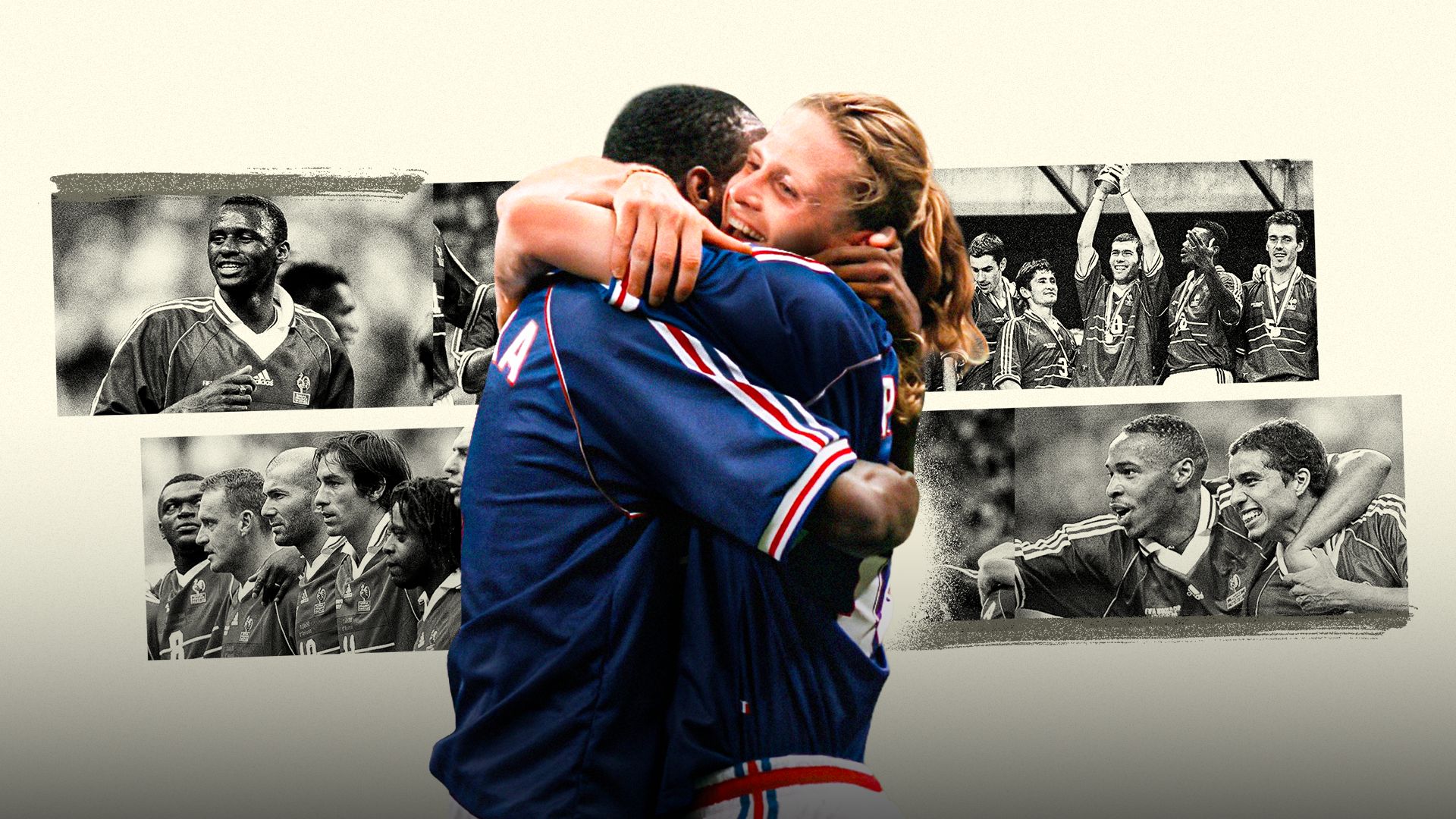
On July 12, 1998, France won far more than a trophy. They shattered a historical complex and forged a legend that endures to this day.Before that date, French football was haunted by its demons. A founding force behind the world's greatest competitions, France embodied a cruel paradox: an influential nation that was rarely victorious, an inventor unable to master its own creation. Its identity had been shaped by a culture of ‘glorious defeat’ – that nobility in failure which, over the years, had morphed into a genuine psychological burden. To grasp the seismic impact of 1998, one must understand the depth of the wound it healed, a scar born from three converging traumas.The first remains etched in the collective memory as the ‘Seville tragedy’ of 1982. That World Cup semi-final against West Germany stands as a painful legend. Harald Schumacher's assault on Patrick Battiston – leaving him unconscious with broken teeth and damaged vertebrae – was a flagrant injustice that went unpunished. The penalty shootout defeat, after leading 3-1 in an epic period of extra-time, forged the image within France of the ‘magnificent loser’. France's ‘magic square’ of Michel Platini, Alain Giresse, Jean Tigana and Luis Fernandez produced the most beautiful football in the world, yet seemed too romantic, too fragile to triumph. Seville planted a pernicious notion that glorious defeat was preferable to victory without flair – a national narrative as poetic as it was paralysing.The second trauma was one of pure humiliation, as the end of Platini's generation ushered in a catastrophic decade. France failed to qualify for Euro '88 or the 1990 World Cup, and were then eliminated without distinction from Euro '92. However, the national team endured its darkest night on November 17, 1993.That evening at Parc des Princes, a simple draw against Bulgaria would have secured passage to the World Cup in the United States. But in the dying seconds, a devastating counter-attack finished by Emil Kostadinov shattered all hope. Defeat was no longer heroic – it exposed a mental capitulation, a pathetic incompetence. The myth of the ‘magnificent loser’ evaporated, replaced by the ignominious tag of simply being ‘losers’.Finally, the third trauma was that of a tainted victory. On 26 May, 1993, Marseille had proven that France could win by claiming the nation's first European Cup against the mighty AC Milan. This triumph, which should have served as a catalyst, was immediately corrupted by the VA-OM match-fixing scandal that involved Marseille and Valenciennes. Revelations of the rigged match between the pair led to Marseille being stripped of their domestic title and relegated.Four pivotal moments thus marked this dark period: Seville 1982; the failure to qualify for the 1990 World Cup; Marseille's tarnished victory in 1993; and the cruel defeat to Bulgaria later that year, which confirmed the French inferiority complex. Hope proved short-lived, leaving a nation without a single moment of pure glory to cling to.In 1998, then, France wasn't awaiting victory; it craved redemption, liberation from these spectres of the past. It needed an unquestionable triumph to erase the injustice, achieved with mastery to forget the incompetence, and carried by symbols of integrity to wash away the stain.The 1998 World Cup acted as collective catharsis, a psychological liberation that ended decades of inferiority complex. In the aftermath of the final, the French press spoke of a ‘blue planet, entirely blue, the blue of France’.The words chosen weren't those of simple sporting victory, but of rebirth. France, which had ‘prostrated itself’ before Brazil, ‘the Gods of the game’, had just demolished them 3-0. Historical anomaly had become the new reality.This success ended France's ‘Poulidor Syndrome’ – a reference to the celebrated French cyclist Raymond Poulidor who, despite his talent, always finished runner-up in major races without ever winning the Tour de France. This culture of eternal second place, of honourable failure, had stuck to French sport like a limpet. Victory in 1998 liberated a nation that had hidden behind the aesthetics of ‘beautiful football’ to justify its defeats. Suddenly, winning mentality was no longer the preserve of the Germans or Italians. French football could finally embrace ambition without pretence.This liberation came through a profound break with the archetypes of the past. The 1998 team was neither the romantic, vulnerable squad of 1982, nor the arrogant, brittle group of 1993. Its primary strength, contrary to French tradition, was its iron defence. Conceding just two goals in seven matches – one from the penalty spot – they built their triumph on unshakeable solidity. Tactically, Aime Jacquet had constructed a fortress.The heroes of the odyssey weren't just artists like Zinedine Zidane, but defenders like Lilian Thuram, who scored an improbable semi-final brace, or tireless workers like Didier Deschamps and Emmanuel Petit. By winning through discipline, rigour and pragmatism – qualities often derided by a press hungry for panache – France proved another path existed. They broke the curse not by imitating the past, but by rejecting it to forge a new winning identity.The 1998 victory is inseparable from the rehabilitation of its architect, Jacquet. A national team manager who became a pariah, then national hero, his journey is that of a man who transformed hostility into fuel.Before being carried in triumph, Jacquet had to fight a war alone against almost everyone, facing a media campaign of unprecedented violence. Led primarily by the newspaper L'Equipe, the criticism was systematic and personal. They reproached him for everything: his playing philosophy deemed timid, his selection choices – notably the exclusion of stars Eric Cantona and David Ginola – his provincial accent and his image as a ‘rough’ man incapable of leading France to the summit.The conflict erupted as the World Cup approached. When Jacquet announced a preliminary squad of 28 players, L'Equipe's front page screamed: "And we're playing with 13?" This attack symbolised the contempt of a certain media elite for a man they deemed outdated. Yet this campaign produced the opposite effect. A poll commissioned by the newspaper to discredit him revealed that 72 per cent of the French public had confidence in Jacquet, which begun a profound fracture between opinion-makers and popular sentiment. Jacquet, the man of provincial France, embodied values of hard work, silence and determination that resonated powerfully across the country.Facing this storm, Jacquet's method was a model of leadership. He built a bubble to protect his squad from external attacks, while his management rested on meticulous planning where nothing was left to chance, direct and honest communication with his players, and unwavering loyalty to those who bought into his project. He promised injury-hit defender Bixente Lizarazu that he would wait for him, and kept his word. He made collective strength an obsession, a non-negotiable principle. Marcel Desailly would later summarise Jacquet’s methods as educating his players "with an iron fist in a velvet glove".The final victory, then, wasn't merely a sporting triumph, but resounding validation of Jacquet’s vision. His famous declaration on the evening of July 12 – "I will never forgive" – wasn't just personal bitterness; it was an assertion that this title had been won against the experts' advice, and through the strength of a squad united in adversity.Beyond the pitch, this victory sparked a cultural revolution within the French Football Federation (FFF). By proving a manager could succeed by resisting pressure and following a long-term vision, Jacquet made the position sacrosanct. He created a precedent that durably reinforced the authority and legitimacy of his successors, offering them unprecedented latitude. Deschamps, his heir, benefited from this consolidated power to impose his own bold choices, knowing that the 1998 victory had set in stone the principle that the national team manager is the sole man in charge.The 1998 legacy isn't measured solely in trophies or memories; it's transmitted directly, almost organically, through the men who forged it. The most evident and enduring lineage is that linking Jacquet to his captain, Deschamps.On the pitch, Deschamps was Jacquet's relay, his brain, the one who translated his tactical vision into action. Twenty years later, having become manager, he appeared as his mentor's natural heir, the continuation of a philosophy that was proven to work at the highest level.The similarities between the two men are striking. Both share the same conception of football, founded on pragmatism, the primacy of collective over individuals, and an obsession with defensive solidity. Like Jacquet, Deschamps has often been criticised for less-than-spectacular performances, yet his formidable efficiency has silenced sceptics.Their relationship with the media is equally similar: controlled, distant, sometimes abrasive communication, aimed above all at protecting the squad from external pressure. Jacquet himself acknowledged this kinship: "It would be presumptuous to say he's my spiritual son. I think we surely have, modestly, more or less the same trajectory, the same philosophy of football and life".This continuity manifested itself brilliantly during the 2018 World Cup. Deschamps' France, like Jacquet's, wasn't the tournament's most flamboyant team, but it was the most solid, tactically intelligent and united. Building success on a compact defensive block and rapid counter-attacks, Deschamps applied the lessons of 1998. He proved that Jacquet's legacy wasn't merely a memory, but a management method and winning culture that was still entirely relevant.By becoming the third man in history to win the World Cup as both player and manager, Didier Deschamps didn't just write his own legend; he ensured the perpetuity of 1998's legacy, transforming it into genuine DNA for the French national team.

.jpg)
Most Popular


Dual Season Starts With UC Davis
5 hours ago